01Selection
How to Select the Right Saw Blade for Granite, Marble & Sintered Stone
Start with the material, machine, dimensions, and wet/dry rating; confirm with tool markings and a trial cut.
Most early blade failures are selection errors, not defects: match bond hardness to the material first, then confirm rim type, cutting depth, and rated speed.
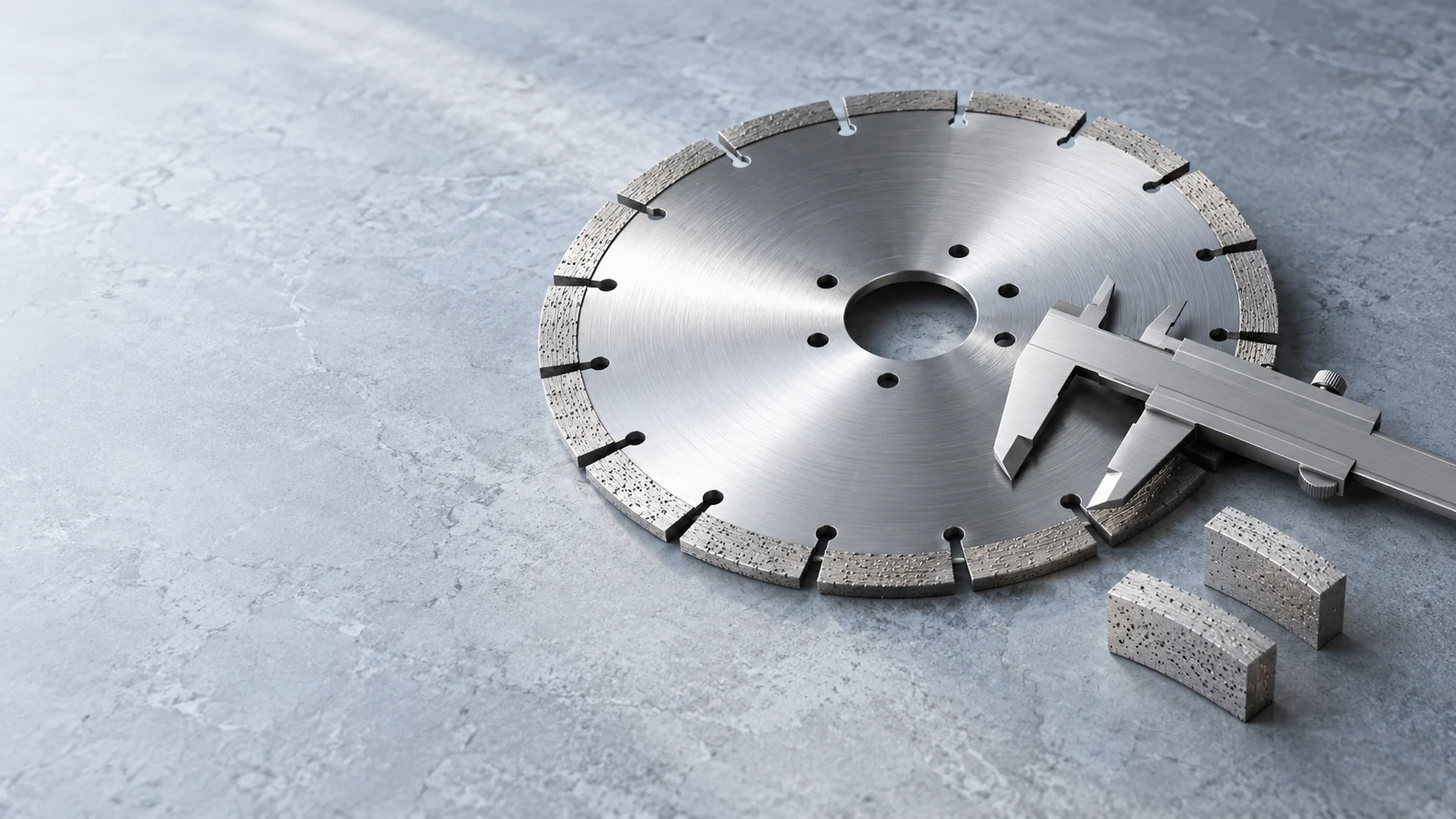
Selection guidance depends on material, machine, and working conditions. Confirm RPM, feed, and cooling against tool markings and machine instructions, then trial the target material.
Content compiled by ADAMA CUT. Compare product specifications with the original Hubei Qianzhao Diamond Tools catalog; verify general process guidance on the actual machine and material. Source catalog PDF
Most premature diamond blade failures are selection problems, not quality problems. A blade keeps cutting because its metal bond wears away at a controlled rate and keeps exposing fresh diamond. Match the bond wear rate to the material first, then confirm rim type, cutting depth, and rated speed for your saw.
Soft, abrasive materials such as asphalt, green concrete, and abrasive block grind the bond down quickly, so they need a hard bond that resists wear; with a soft bond the segments can disappear within a single job. Hard, dense materials such as granite, hard cured concrete, and reinforced concrete barely wear the bond, so they need a soft bond that releases dull diamonds quickly; with a hard bond the blade glazes over, stops cutting, and only polishes the surface.
Segmented rims cut fastest and their gullets clear debris, which makes them the standard choice for concrete and masonry, at the cost of a rougher edge. Turbo rims use a serrated edge to balance speed and finish and suit stone and pavers. Continuous rims give the cleanest, chip-resistant edge for tile and marble but cut more slowly and are almost always used wet.
As a rule of thumb, maximum cutting depth is roughly one third of the blade diameter, less a margin for the arbor and flanges: about 32 mm for a 115 mm blade, 65 mm for 180 mm, 95 mm for 300 mm, 120 mm for 350 mm, and 195 mm for 500 mm. If you regularly cut 100 mm units with a 250 mm blade, plan to cut from both sides or step up a diameter. Always confirm the depth against the saw manufacturer specification.
For the European market, look for blades marked as conforming to EN 13236, the safety standard for superabrasive products. Never exceed the maximum RPM printed on the blade, and match the blade to the saw operating speed, not only to its arbor size. Use laser-welded segments for dry cutting, because dry cutting runs much hotter; brazed segments are generally for wet use only. Keep a steady feed pressure: forcing the blade overheats the segments and can warp the steel core.
State your material first and ask the supplier which bond they recommend for it, instead of choosing by diameter and price alone. Confirm the wet/dry rating, segment height, and arbor size against your saw, and check the blade maximum RPM against the machine operating speed. For EU imports, ask for the EN 13236 conformity marking and the documentation behind it. Trial one blade on your actual material before committing to a batch: cutting behaviour varies with aggregate hardness even within a single material name such as concrete.
| Material you cut | Bond to choose | Rim type | Wet or dry |
|---|---|---|---|
| Asphalt | Hard | Segmented | Dry or wet |
| Green concrete, abrasive block | Hard | Segmented | Wet preferred |
| Medium concrete, brick, pavers | Medium | Segmented or turbo | Dry or wet |
| Hard cured / reinforced concrete | Soft to medium | Segmented | Wet preferred |
| Granite, hard natural stone | Soft | Segmented or turbo | Wet |
| Porcelain tile, marble | Medium to soft | Continuous rim or thin turbo | Wet (dry only if rated) |
Compiled by ADAMA CUT. The source catalog and industry references below do not imply endorsement or certification of our products. Follow the specific tool markings and machine instructions, then trial the target material.
Enter blade diameter and spindle RPM to calculate peripheral speed: v = π × D(mm) × n(rpm) / 60000.
Converts only the target you enter; this tool does not recommend a material speed.
—
A calculation is not a safe-speed or fitment approval. Do not exceed the tool-marked maximum RPM or machine limits. Confirm material, cooling, and feed conditions with a trial cut.
View the original Hubei Qianzhao Diamond Tools Co., Ltd. catalog. ADAMA CUT is its overseas business brand; verify specifications against the source page and confirmed documents.