01Selection
How to Select the Right Saw Blade for Granite, Marble & Sintered Stone
Start with the material, machine, dimensions, and wet/dry rating; confirm with tool markings and a trial cut.
Match bronze or cobalt bond matrices to marble hardness and slurry abrasiveness; standardize tension and dressing.
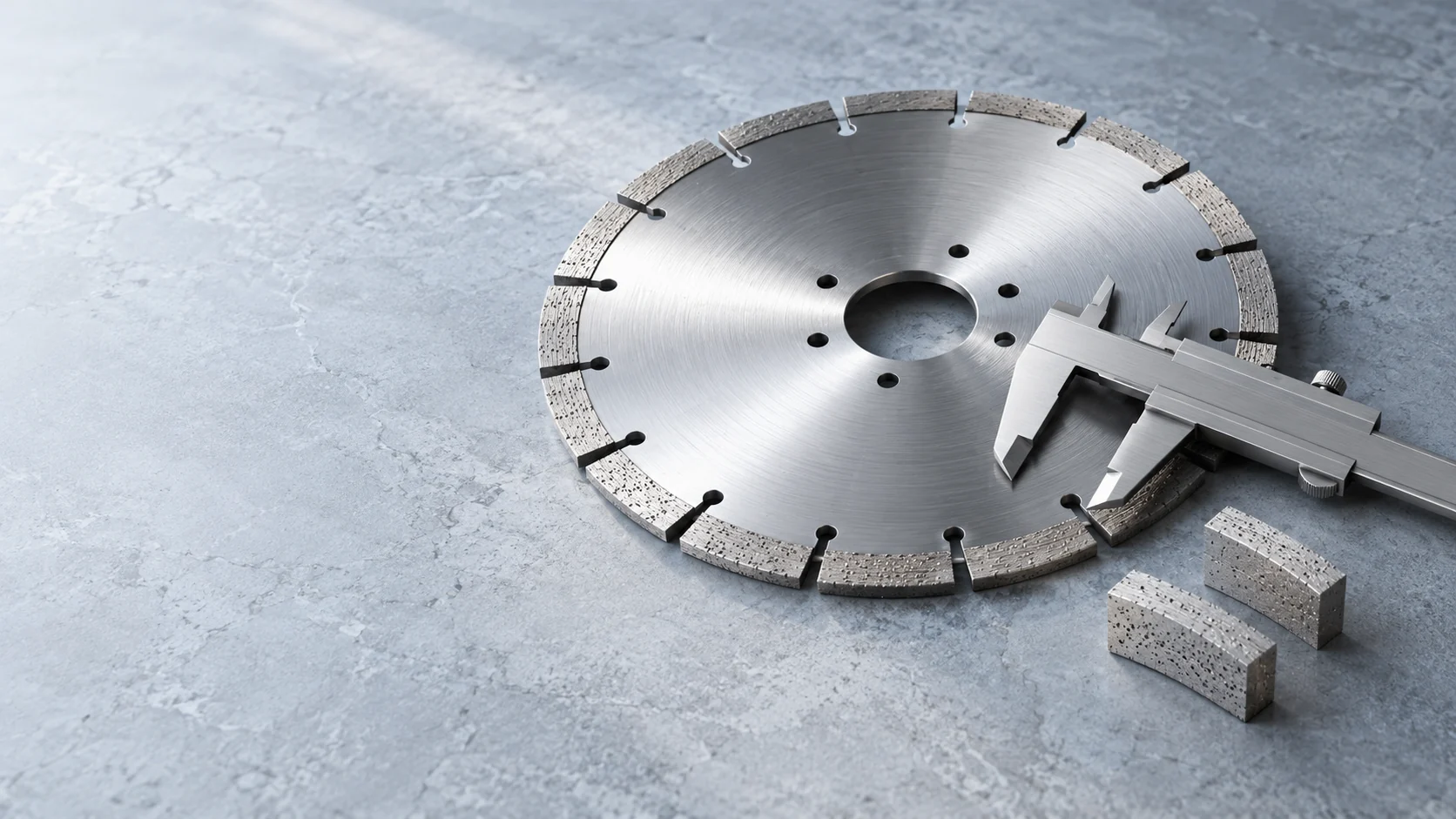
Selection guidance depends on material, machine, and working conditions. Confirm RPM, feed, and cooling against tool markings and machine instructions, then trial the target material.
Content compiled by ADAMA CUT. Compare product specifications with the original Hubei Qianzhao Diamond Tools catalog; verify general process guidance on the actual machine and material. Source catalog PDF
In multi-blade marble gang saws, blade deflection and segment drop are primarily caused by matrix mismatch with stone abrasiveness, uneven blade tension, or unbalanced slurry density. Match matrix formulation to the specific stone variety, and dress new segments on refractory brick or abrasive sandstone before full feed.
Gang saw segments use bronze, iron-copper, or pre-alloyed cobalt bonds. Softer marbles require wear-resistant matrices to prevent premature loss; dense crystalline marbles require self-sharpening bonds to avoid segment glazing. High-strength medium/coarse diamond grit (30/40 to 40/50 mesh) maintains stable segment exposure.
Hydraulic tensioning must maintain uniform load across all blades (typically 70–90 kN per machine builder specifications) to prevent slab thickness variation. Downward feed must follow a staged protocol: slow dressing feed (0.5–1.0 m/h) for new segments, rated production feed on steady stone, and decelerated exit at the block bottom.
When wavy cuts or lateral deflection occur, stop the frame and check blade tension and guide slider clearance first. Then verify slurry density (excessive density hinders debris evacuation and accelerates lateral wear; thin slurry reduces lubrication). Never force feed rates during noticeable blade oscillation.
| Stone Characteristics | Recommended Matrix | Diamond Mesh & Exposure | Key Process Control Points |
|---|---|---|---|
| White / Beige Marble (Soft-Medium, Low Abrasive) | Wear-resistant Cu-Fe bond | 30/40 to 35/45 mesh, 0.2–0.35mm exposure | Maintain steady water flow to prevent premature segment matrix erosion |
| Dense Crystalline Marble (High Density, Prone to Glaze) | Self-sharpening Cobalt / Pre-alloy bond | 40/50 mesh high-strength diamond for controlled micro-fracturing | Periodic redressing with refractory brick; monitor main motor amperage |
| Sandy / Calcitic Marble (Highly Abrasive) | High-wear hard matrix with lateral protection | 30/40 mesh medium concentration with wear-resistant side segments | Strictly regulate slurry settling pond density (1.15–1.25 g/cm³) |
Compiled by ADAMA CUT. The source catalog and industry references below do not imply endorsement or certification of our products. Follow the specific tool markings and machine instructions, then trial the target material.
Enter blade diameter and spindle RPM to calculate peripheral speed: v = π × D(mm) × n(rpm) / 60000.
Converts only the target you enter; this tool does not recommend a material speed.
—
A calculation is not a safe-speed or fitment approval. Do not exceed the tool-marked maximum RPM or machine limits. Confirm material, cooling, and feed conditions with a trial cut.
View the original Hubei Qianzhao Diamond Tools Co., Ltd. catalog. ADAMA CUT is its overseas business brand; verify specifications against the source page and confirmed documents.