01Selection
How to Select the Right Saw Blade for Granite, Marble & Sintered Stone
Start with the material, machine, dimensions, and wet/dry rating; confirm with tool markings and a trial cut.
Tooling standards for 45-degree miter cuts, CNC finger bit feeds, and corner pre-drilling for stress relief.
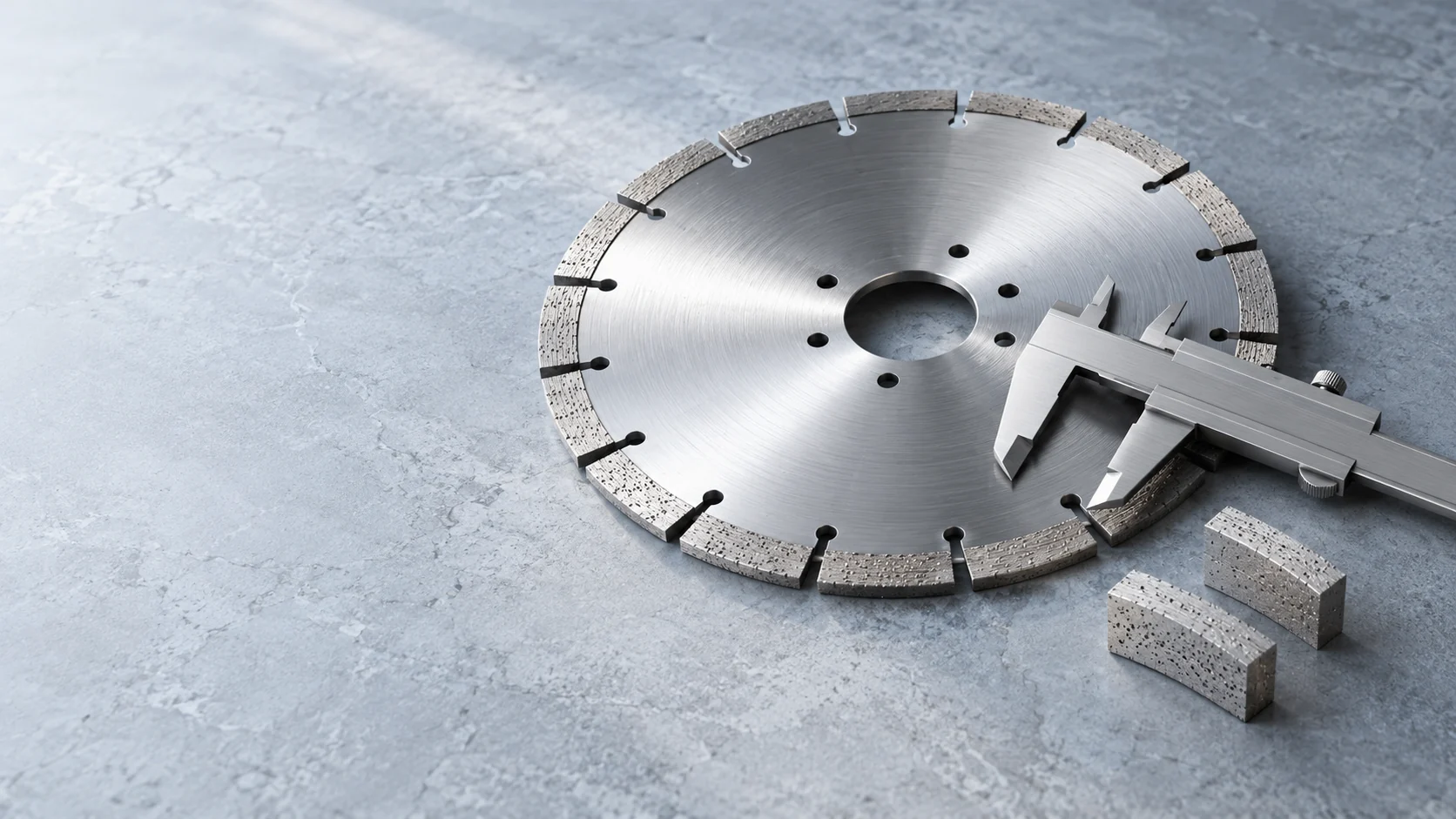
Selection guidance depends on material, machine, and working conditions. Confirm RPM, feed, and cooling against tool markings and machine instructions, then trial the target material.
Content compiled by ADAMA CUT. Compare product specifications with the original Hubei Qianzhao Diamond Tools catalog; verify general process guidance on the actual machine and material. Source catalog PDF
Sintered stone features high Mohs hardness (6–7), near-zero water absorption (<0.05%), and internal residual tension. For 45-degree miter joints and sink cutouts, operators must employ fine-grit close-pitch thin blades and internal-water-feed CNC finger bits. Sharp 90° inside corners are strictly prohibited; always drill stress-relief radii first.
High-end miter joints demand a razor-sharp glazed edge without scalloping. Select dedicated silent 45° sintered stone blades (thin core 2.2–2.6mm, tight narrow slots). Maintain peripheral blade speed at 28–34 m/s, forward feed at 0.8–1.8 m/min, and reduce feed by 50% at both entry and exit boundaries.
Sink cutouts require pre-drilling four corner holes using 20–35mm core drills (corner radius R≥5mm) to disperse stress concentrations. For pocketing, use center-water-feed diamond finger bits at 4,500–6,000 RPM, with horizontal feed at 200–400 mm/min and high-pressure internal water to purge slurry instantly.
Machine workbenches must be flat and rigid, topped with high-density rubber or grooved polyethylene slabs. Workpieces require secure mechanical or pneumatic clamping on both sides of the kerf line to eliminate vibration harmonics that cause sub-surface micro-fractures.
| Operation | Recommended Tooling | Key Operating Parameters | Stress & Crack Prevention Criticals |
|---|---|---|---|
| 45° Miter Bevel Cutting | 350/400mm Silent close-pitch sintered stone blade (J-slot / short teeth) | Linear speed 28–34 m/s, feed 0.8–1.6 m/min | Decelerate traverse feed by 50% at entry/exit; clamp pressure beam to stop slab flutter |
| Corner Relief Pre-Drilling | Ø20–35mm Vacuum brazed or fine-grit core drill | RPM 2,500–3,500, plunge feed 15–30 mm/min | Strictly forbid sharp 90° inside corners; R≥5mm fillet disperses residual slab stress |
| CNC Sink Pocket Routing | Ø18–22mm High-density center-water-feed diamond finger bit | Spindle RPM 4,500–6,000, feed 200–350 mm/min | Connect high-pressure internal water (≥0.3 MPa); continuous slurry flushing prevents thermal shock |
| Edge Profiling & Polish | Resin-bond diamond profiling wheels (50#–800# grit sequence) | Spindle RPM 3,000–4,500, progressive polishing | Eradicate previous cutting micro-scratches sequentially; ensure steady water lubrication |
Compiled by ADAMA CUT. The source catalog and industry references below do not imply endorsement or certification of our products. Follow the specific tool markings and machine instructions, then trial the target material.
Enter blade diameter and spindle RPM to calculate peripheral speed: v = π × D(mm) × n(rpm) / 60000.
Converts only the target you enter; this tool does not recommend a material speed.
—
A calculation is not a safe-speed or fitment approval. Do not exceed the tool-marked maximum RPM or machine limits. Confirm material, cooling, and feed conditions with a trial cut.
View the original Hubei Qianzhao Diamond Tools Co., Ltd. catalog. ADAMA CUT is its overseas business brand; verify specifications against the source page and confirmed documents.