01Selection
How to Select the Right Saw Blade for Granite, Marble & Sintered Stone
Start with the material, machine, dimensions, and wet/dry rating; confirm with tool markings and a trial cut.
Measure concrete Mohs hardness, follow the inverse bond rule, and standardize scratch transition protocols.
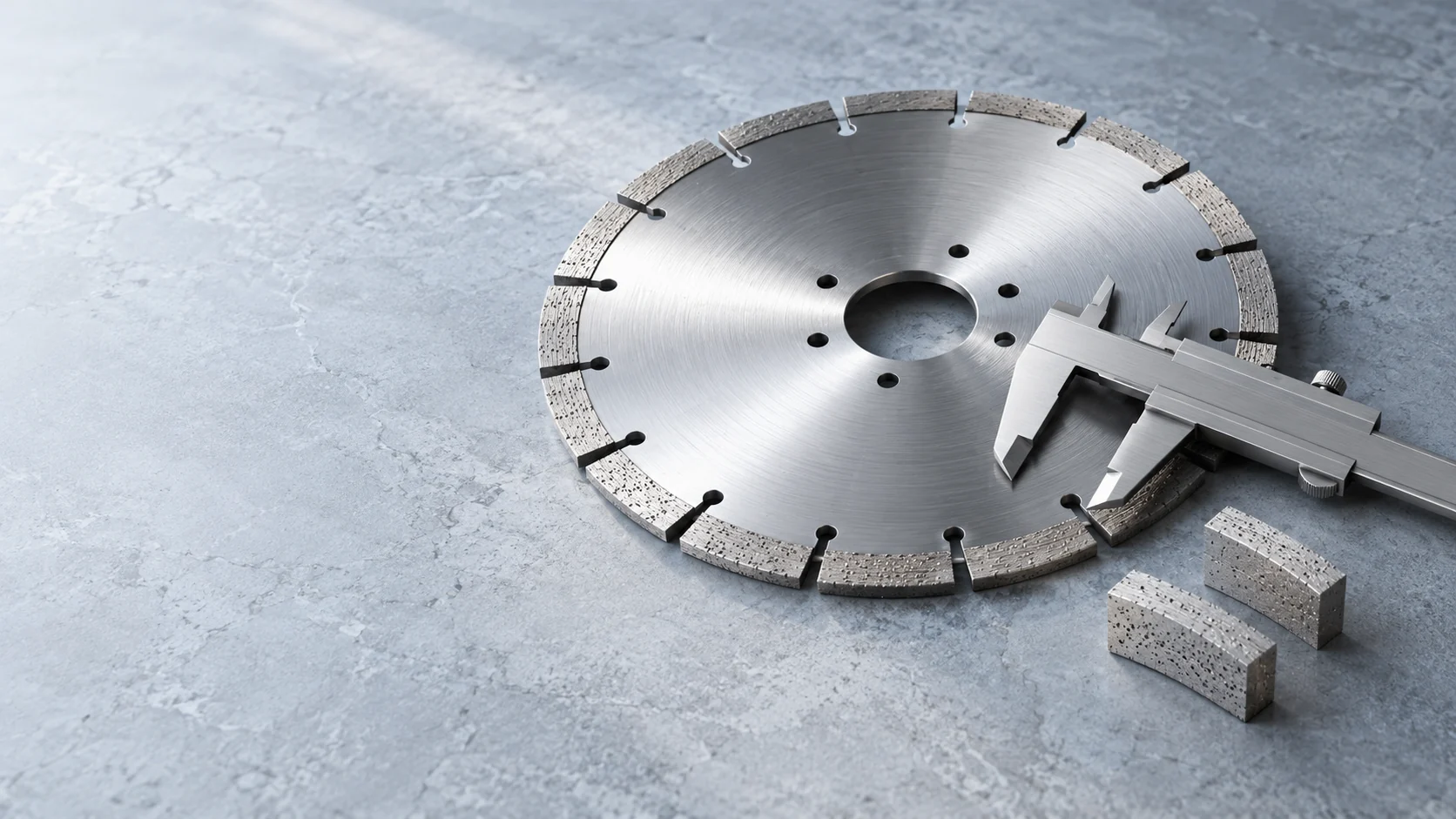
Selection guidance depends on material, machine, and working conditions. Confirm RPM, feed, and cooling against tool markings and machine instructions, then trial the target material.
Content compiled by ADAMA CUT. Compare product specifications with the original Hubei Qianzhao Diamond Tools catalog; verify general process guidance on the actual machine and material. Source catalog PDF
Concrete surface preparation must follow the inverse bond rule: use extra-soft bond shoes on hard concrete, and extra-hard bond shoes on soft, abrasive floors. Always test the bare slab with a Mohs scratch kit before selecting tooling; guessing bond hardness by design strength (psi/MPa) leads to glazed shoes or rapid diamond loss within hours.
Ultra-hard slabs (Mohs 6–8, densified or high-strength concrete) require Extra Soft Bond, where copper-cobalt matrix wears steadily to expose fresh diamond edges. Hard slabs (Mohs 5–6) require Soft Bond. Medium slabs (Mohs 4–5) use Medium Bond. Soft or rain-damaged abrasive slabs (Mohs 2–3) demand Hard to Extra Hard Bond to prevent loose sand from eroding the segment prematurely.
Never skip grit steps during metal grinding: start at 16/20# (heavy leveling or epoxy coating removal) → 30/40# (base surface opening) → 60/80# (scratch refinement) → 120/150# (scratch homogenization). Skipping grits traps deep gouges under fine scratches, which reappear as cloudy halos under final high-gloss burnishing.
Between metal-bond grinding and flexible resin polishing, always run 50# or 100# ceramic or hybrid transition pucks. Transition pads remove deep metal scratches rapidly while withstanding heavy grinder head pressure, preventing resin pads from melting or smearing under high friction heat.
| Concrete Hardness Level | Mohs Hardness Scale | Corresponding Matrix Bond | Jobsite Behavior & Operational Risk |
|---|---|---|---|
| Ultra-Hard / Densified Burnished Slab | Mohs 6–8 (C40–C60+) | Extra Soft Bond (Copper/Cobalt alloy matrix) | Prone to glazing; add machine head weights, apply water mist to aid self-sharpening |
| Medium / Standard Commercial Slab | Mohs 4–5 (C25–C35) | Medium Bond (Balanced Fe-Cu matrix) | Optimal balance between stock removal and wear life; controlled dust evacuation |
| Soft / Rain-Damaged Sandy Slab | Mohs 2–3 (High Abrasiveness) | Super Hard Bond (Tungsten carbide reinforced matrix) | Aggressive free sand quickly wears bonds; soft bonds will vanish in under 100 m² |
| Metal-to-Resin Transition Stage | All hardness ranges | Ceramic / Hybrid Transition Pucks (50# / 100#) | Removes deep metal swirl marks completely; creates flawless base for 200#–3000# resin polishing |
Compiled by ADAMA CUT. The source catalog and industry references below do not imply endorsement or certification of our products. Follow the specific tool markings and machine instructions, then trial the target material.
Enter blade diameter and spindle RPM to calculate peripheral speed: v = π × D(mm) × n(rpm) / 60000.
Converts only the target you enter; this tool does not recommend a material speed.
—
A calculation is not a safe-speed or fitment approval. Do not exceed the tool-marked maximum RPM or machine limits. Confirm material, cooling, and feed conditions with a trial cut.
View the original Hubei Qianzhao Diamond Tools Co., Ltd. catalog. ADAMA CUT is its overseas business brand; verify specifications against the source page and confirmed documents.