01Selection
How to Select the Right Saw Blade for Granite, Marble & Sintered Stone
Start with the material, machine, dimensions, and wet/dry rating; confirm with tool markings and a trial cut.
Master the linear speed equation v = πDn / 60000; calculate optimal RPM and feed rates across materials.
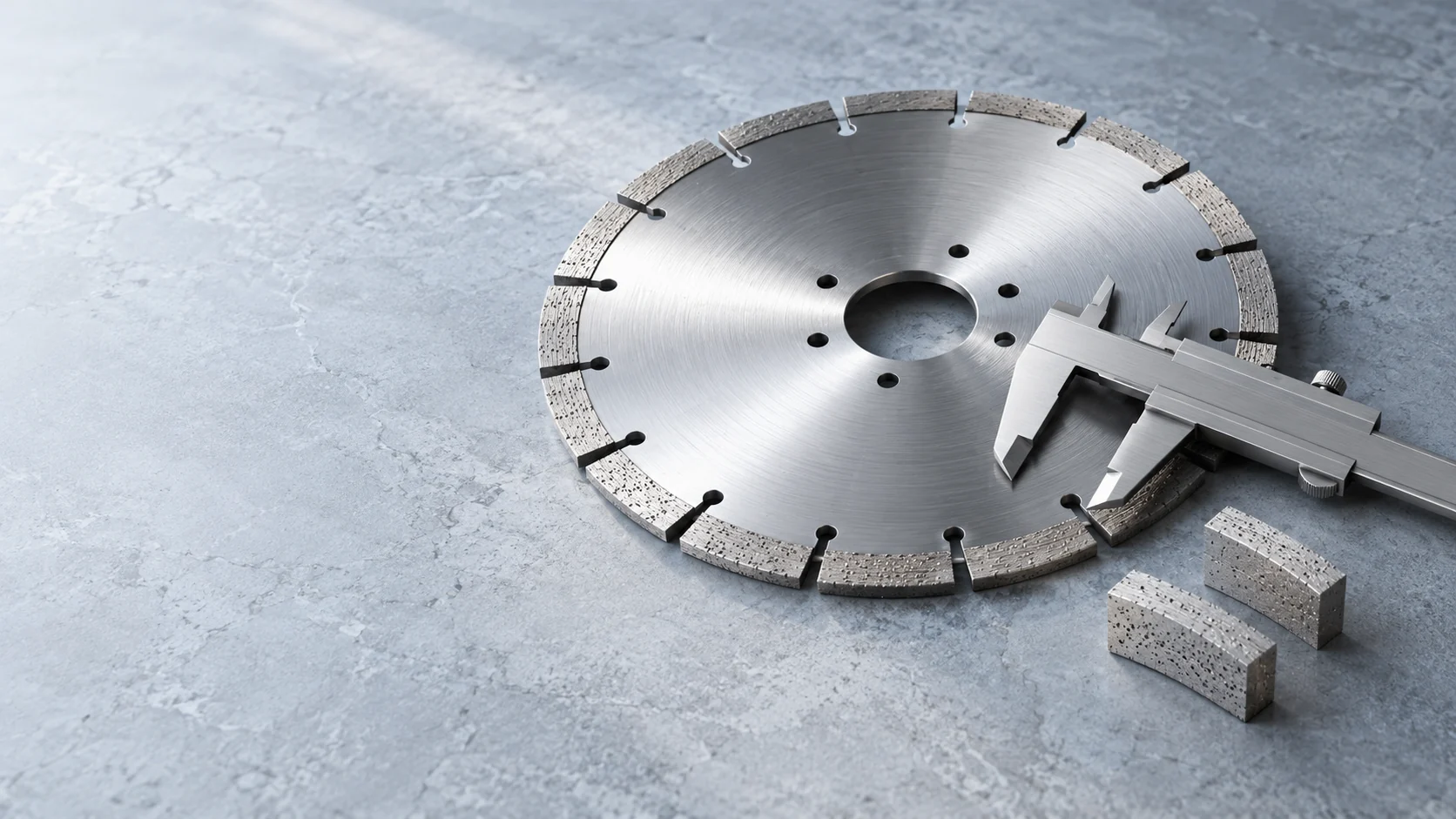
Selection guidance depends on material, machine, and working conditions. Confirm RPM, feed, and cooling against tool markings and machine instructions, then trial the target material.
Content compiled by ADAMA CUT. Compare product specifications with the original Hubei Qianzhao Diamond Tools catalog; verify general process guidance on the actual machine and material. Source catalog PDF
Linear cutting speed (m/s) determines segment self-sharpening equilibrium and core dynamic tension. Spindle speed (RPM) must always be calculated against blade outer diameter (mm): v = (π × D × n) / 60000. Over-speeding causes core instability and catastrophic safety hazards; under-speeding subjects individual diamond crystals to excessive impact load, causing premature pull-out.
Hard granite and quartzite: 25–35 m/s; soft marble and limestone: 35–48 m/s; ultra-compact sintered stone: 28–34 m/s; reinforced cured concrete wet cutting: 30–40 m/s; asphalt: 40–50 m/s. Never exceed the marked Maximum Safe RPM stamped on the blade core.
Machine cutting follows two principles: deep-slow or shallow-fast step cutting. For hard granites and thick slabs, step cutting (cut depth 5–15mm per pass at 1.5–3.5 m/min traverse) reduces spindle motor torque load, preserves core tension, and prevents blade deflection far better than single-pass deep cuts.
350mm blades require ≥11 kW spindle motor power; 600mm blades require ≥15 kW; 1600–2200mm block cutters require ≥37–55 kW. Wet cutting coolant line pressure should maintain ≥0.2 MPa, with dual nozzles aimed squarely at the kerf entry on both sides of the blade core.
| Blade Diameter (mm) | Optimal Linear Speed (m/s) | Calculated Spindle Speed (RPM) | Typical Materials & Machinery |
|---|---|---|---|
| Ø115–125mm (4.5"–5") | 40–70 m/s (rated for angle grinders) | 6,000–11,000 RPM (tool rating constrained) | Tile, thin stone, mortar raking (Handheld angle grinders) |
| Ø350mm (14" Standard Bridge) | 28–36 m/s (Granite / Sintered stone baseline) | 1,500–1,950 RPM | Granite countertops, quartz, sintered slabs (CNC bridge saw) |
| Ø400mm (16" Heavy Bridge) | 30–38 m/s (Marble / Granite standard) | 1,450–1,800 RPM | Thick marble slabs, dimensional pavers (Bridge trim saw) |
| Ø600–800mm (Floor / Road Saw) | 35–45 m/s (Concrete / Thick curbing) | 1,100–1,450 RPM | Granite curb cutting, floor expansion joints (Walk-behind road saws) |
Compiled by ADAMA CUT. The source catalog and industry references below do not imply endorsement or certification of our products. Follow the specific tool markings and machine instructions, then trial the target material.
Enter blade diameter and spindle RPM to calculate peripheral speed: v = π × D(mm) × n(rpm) / 60000.
Converts only the target you enter; this tool does not recommend a material speed.
—
A calculation is not a safe-speed or fitment approval. Do not exceed the tool-marked maximum RPM or machine limits. Confirm material, cooling, and feed conditions with a trial cut.
View the original Hubei Qianzhao Diamond Tools Co., Ltd. catalog. ADAMA CUT is its overseas business brand; verify specifications against the source page and confirmed documents.