01Selection
How to Select the Right Saw Blade for Granite, Marble & Sintered Stone
Start with the material, machine, dimensions, and wet/dry rating; confirm with tool markings and a trial cut.
Step-by-step diagnosis of edge chipping, cut deflection, wobble, and segment burning on CNC bridge saws.
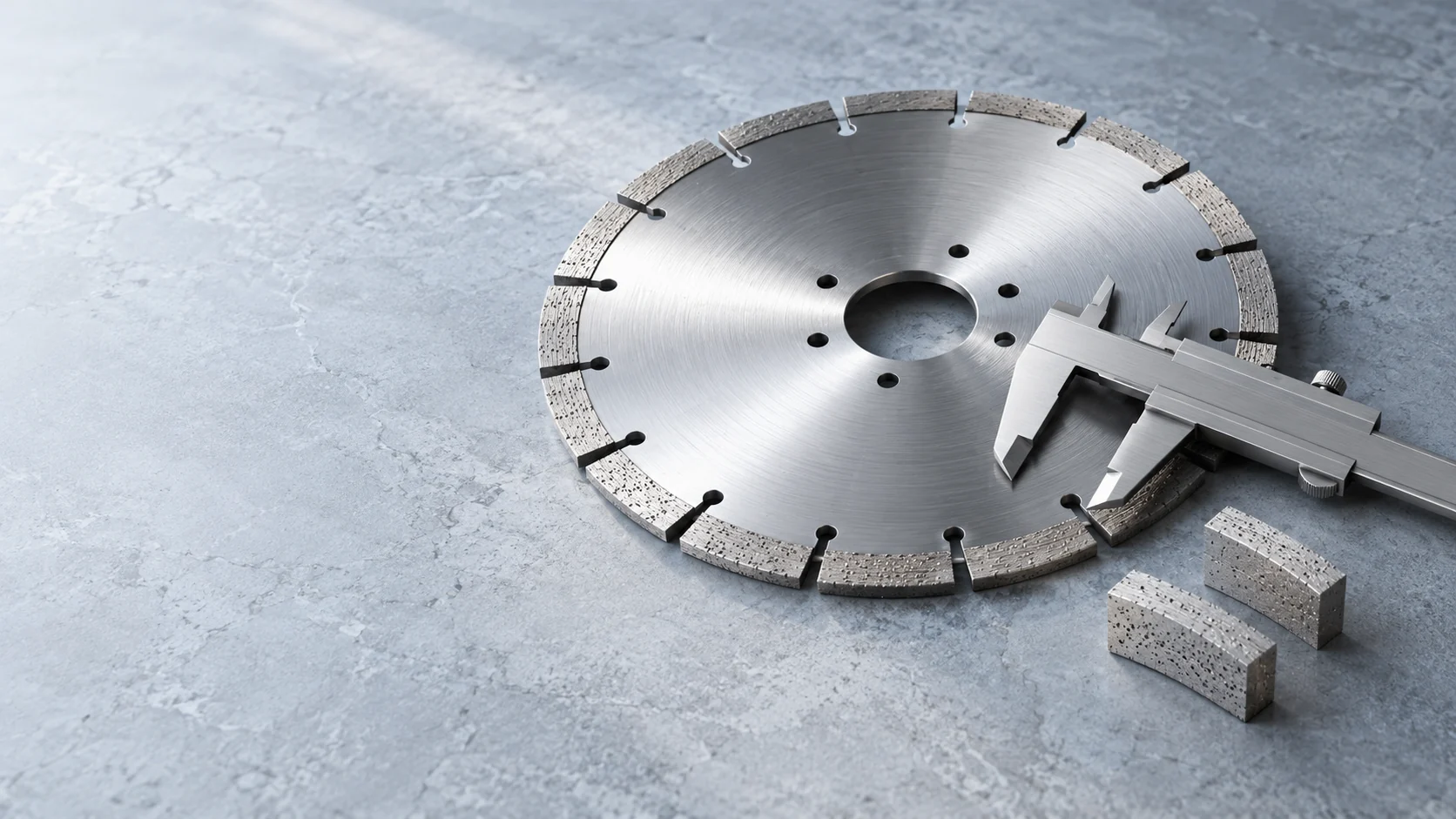
Selection guidance depends on material, machine, and working conditions. Confirm RPM, feed, and cooling against tool markings and machine instructions, then trial the target material.
Content compiled by ADAMA CUT. Compare product specifications with the original Hubei Qianzhao Diamond Tools catalog; verify general process guidance on the actual machine and material. Source catalog PDF
When bridge saws produce chipped edges or cut deflection, do not assume blade defect immediately. Isolate variables systematically: machine geometry (flange runout and spindle play) → bed support rigidity → linear speed and feed matching → coolant delivery and diamond exposure.
Entry chipping typically results from blunt diamond exposure causing excessive impact, or overly aggressive plunge rate. Exit blowout occurs when stone underside lacks solid bed support or feed is not decelerated as the blade breaks through. Continuous chipping indicates excessive blade axial runout (keep flange face runout under 0.05mm) or worn spindle bearings.
If cut kerf curves or wanders sideways, inspect blade segment side clearance for asymmetrical wear. One-sided coolant flow, foreign debris or rust clamped inside the flanges, or thermal stress release in the steel core will generate unbalanced lateral forces, forcing the blade to deflect.
Blue-black thermal discoloration on the steel core or glazed segment surfaces indicates coolant starvation in the arc of cut, or bond matrix hardness exceeding stone abrasiveness. Immediately aim dual coolant jets directly at the kerf entry on both sides, increase water flow, and redress the segments on a refractory brick at low traverse speed.
| Cutting Defect | Direct Physical Cause | First Machine / Setup Check | Field Corrective Action |
|---|---|---|---|
| Entry Chipping / Continuous Micro-chips | Insufficient diamond exposure; excessive flange axial runout | Dial indicator test on flange face (≤0.05mm); check spindle bearing play | Redress on refractory brick; resurface or replace worn flanges, clean clamping surfaces |
| Exit Corner Blowout / Broken Slab | Unsupported underside at cut exit; excessive traverse feed at breakthrough | Inspect table bed wooden/polyethylene slats for flat, gap-free slab support | Install dense backing sacrificial bed; decelerate traverse speed by 50% during final 30mm |
| Lateral Cut Deflection / Tapered Kerf | Uneven one-sided coolant; steel core tension loss or thermal warping | Verify equal water flow from dual nozzles; inspect blade vertical squareness | Align dual-nozzle coolant directly into cut arc; re-tension core, reduce traverse rate |
| Segment Blue Burn / Severe Smoke | Severe coolant starvation; matrix bond too hard causing friction runaway | Check water line pressure and nozzles; ensure coolant penetrates cut arc | Increase flow rate to ≥25 L/min; switch to softer self-sharpening matrix blade |
Compiled by ADAMA CUT. The source catalog and industry references below do not imply endorsement or certification of our products. Follow the specific tool markings and machine instructions, then trial the target material.
Enter blade diameter and spindle RPM to calculate peripheral speed: v = π × D(mm) × n(rpm) / 60000.
Converts only the target you enter; this tool does not recommend a material speed.
—
A calculation is not a safe-speed or fitment approval. Do not exceed the tool-marked maximum RPM or machine limits. Confirm material, cooling, and feed conditions with a trial cut.
View the original Hubei Qianzhao Diamond Tools Co., Ltd. catalog. ADAMA CUT is its overseas business brand; verify specifications against the source page and confirmed documents.